Tech investors are back in record territory, but the relentless rally carries an expensive question.
The Nasdaq is up 15% in 2026, even as the AI arms race continues to accelerate, according to Reuters.
Consensus estimates put combined CapEx spending by five of the biggest U.S. hyperscalers near $730 billion this year, as per Reuters, prompting Wall Street to question whether cloud and AI revenue can continue to outpace the cash going into data centers.
Legendary fund manager Stanley Druckenmiller has hardly sounded euphoric.
Earlier this year, the billionaire investor said that AI was no longer playing the starring role in his illustrious portfolio, recalling that the trade had become “disturbingly heated” last summer.
That makes his big Q2 move especially interesting.
Druckenmiller’s Duquesne Family Office opened a brand-new position in one of the most dominant tech companies in the world, investing in 336,300 shares valued at roughly $120 million at quarter-end.
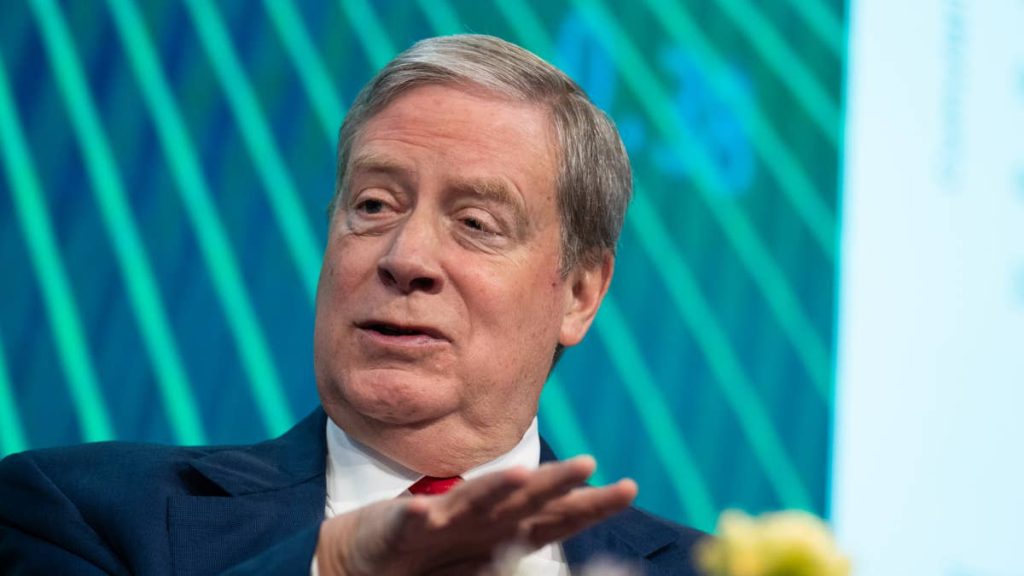
Jeenah Moon/Bloomberg via Getty Images
Druckenmiller reenters Alphabet with a $120 million bet
Druckenmiller just dropped $120 million on Google-parent Alphabet (GOOG) in Q2, according to an SEC filing.
More Manager Buy/Sells:
- Michael Burry increases his bet against popular chip giant
- Warren Buffett reveals he broke his own investing pattern
- Mark Cuban bets on MLB with Athletics minority stake
Duquesne owned zero Alphabet shares at the end of Q1 after selling the entire 385,000-share position. By June 30, he was back with 336,300 Class A shares worth north of $120.2 million, according to 13f.info.
In many ways, that reversal fits Druckenmiller’s approach.
He has often said that most trades are usually conceived over an 18-month-to-three-year horizon, but he heads for the exit or reverses them quickly when the facts change.
Additionally, he focuses on what the business may look like going forward, rather than what investors are already aware of.
Alphabet’s quarterly numbers give that forward-looking thesis plenty to work with. Q2 sales revenue has surged 24% to $119.8 billion, while operating income rose 30% to $40.8 billion. More importantly for the AI thesis, Google Cloud sales supercharged 82% to $24.8 billion, and Cloud operating income more than tripled to $8.8 billion.
The demand pipeline is also getting harder to brush aside.
Google Cloud backlog surged to $513.9 billion at quarter-end, up from $462.3 billion in March, with Alphabet expecting to recognize just over 50% of total backlog over the next 24 months.
What sets Google apart in the AI race is that it acts as both an AI platform and an infrastructure provider.
Gemini models, enterprise AI products, custom TPUs, Search, and Cloud offer multiple ways to monetize the same compute buildout, rather than relying on a single AI product.
Interestingly, Druckenmiller isn’t alone in seeing something there. Warren Buffett’s Berkshire Hathaway (BRK.A, BRK.B) also disclosed an Alphabet stake in Q3 2025 and has since substantially increased it, raising the position by another 83% in Q2 2026 to 106 million shares, according to Investing.
Moreover, the stock has also pulled back from its May record above $400 to about $346, offering a more attractive entry point according to Yahoo Finance.
Druckenmiller’s other big Q2 moves
Alphabet was far from being Duquesne’s most aggressive move.
During Q2, Druckenmiller spread capital across AI infrastructure, biotech, and media.
Amazon (AMZN) was perhaps the most clear increase. Duquesne added 495,800 shares, beefing up the position more than tenfold to 541,600 shares worth $129.1 million. It also added 259,300 shares underlying Amazon calls, taking the position to an impressive 459,300 shares worth $109.5 million.
Amazon killed it with its Q2 results, spearheaded by a superb AWS showing, with Q2 cloud sales up 37% to $42.2 billion and AWS operating income reaching $16.6 billion. That gives Druckenmiller AI exposure through a business that’s already converting CapEx into higher growth and profits.
Taiwan Semiconductor (TSM) remained another major AI-chain bet.
Duquesne added 94,400 shares, bumping the stake to 19% to 589,680 shares worth $281.6 million. TSMC’s Q2 profit skyrocketed 77% as per Reuters, while management bumped 2026 sales expectations and capital spending on persistent AI-chip demand.
Similarly, the family office loaded up on STMicroelectronics (STM), increasing its stake by 490,000 shares to 3.10 million, valued at $232.4 million.
Though it may look more contrarian on paper, STM’s Q2 sales jumped 26%, and management expects acceleration from AI-data-center and low-Earth-orbit programs.
Insmed (INSM) was a concentrated position in the healthcare space, where Duquesne added 270,600 common shares to 1.42 million, worth $151.9 million, while opening call options covering another 1.35 million shares worth $143.9 million. The company’s non-cystic fibrosis medicine BRINSUPRI revenue jumped 49% sequentially in Q2, prompting higher full-year guidance.
Seagate (STX) increased by 71,300 shares to 122,000, worth $117.7 million, targeting the AI infrastructure trend as the company’s fiscal Q4 free cash flow reached $1.1 billion.
Natera (NTRA) gained 122,700 shares, taking Duquesne’s stake to 3.19 million shares worth $864.9 million. The company’s Q2 salesimpressed, growing 37.7%, and oncology testing volumes jumped 57.2%, underscoring the case for continued gains in diagnostic market share.
Finally, Duquesne initiated a 2.20 million-share position in Fox (FOXA), worth $115.0 million, targeting robust advertising growth at the media company.
Stanley Druckenmiller’s investing strategy explained
Druckenmiller built his reputation by layering macro analysis with concentrated, high-conviction bets.
He founded Duquesne Capital in 1981 and ran the hedge fund through 2010, handling external capital with nearly 30% annualized returns and no losing years. Today, he manages his own capital through Duquesne Family Office, with Forbes putting his net worth at $7.8 billion.
His investing approach is highly adaptive.
Druckenmiller is looking for major economic and technological shifts, using companies and market internals to test the macro picture, and sizing aggressively when conviction is high.
“Sometimes when the opportunity is so big and you just kind of know it, you’ve just got to plunge in without the proper information,” Druckenmiller said recently.
His mindset has produced some of the most prescient market calls.
While managing billionaire George Soros’ capital, Druckenmiller identified a major weakness in the British pound ahead of the 1992 sterling crisis, which helped drive a trade generating north of $1 billion, according to Investopedia.
More recently, Druckenmiller scooped up shares of Nvidia stock in late 2022, before ChatGPT ignited the AI boom, according to Yahoo Finance, and then continued adding to his position as conviction grew.
Related: 5-star analyst sets jaw-dropping Micron stock price target for 2026