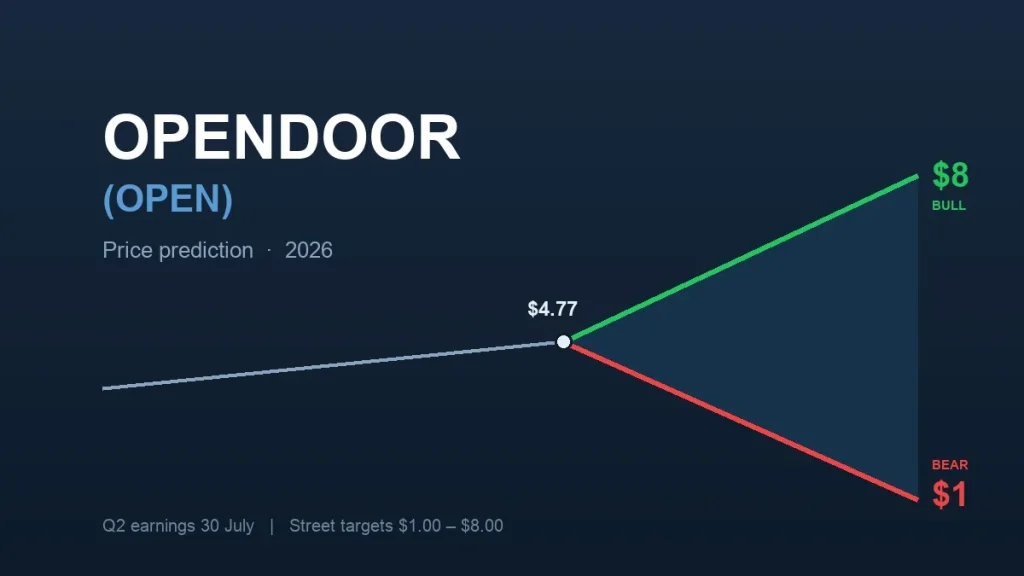
Opendoor is not a bet on house prices. That is the single most common misconception about the stock, and it is now factually out of date. Since CEO Kaz Nejatian took over last September, the company has torn out the mechanism that made it a leveraged wager on home price appreciation and replaced it with something the readers of this publication will recognise instantly: a market-making desk. Opendoor buys inventory, holds it briefly, and sells it for a spread. It is trying to win on turnover, not on direction. That reframing is the whole investment case — and it explains why Wall Street’s price targets on Opendoor (OPEN) currently run from $1.00 to $8.00, an eightfold spread, against a share price of $4.77 at the 10 July close, with a consensus target of just $4.82 across nine analysts, according to StockAnalysis.
Read that target range again, because it is the tell. An 8x gap between the low and the high is not a disagreement about the housing market — every analyst on the list is looking at the same mortgage rates and the same inventory data. It is a disagreement about whether an inventory-velocity business can be run profitably at scale at all. And that is a question the trading industry has answered before. Value Opendoor the way you would value a liquidity provider, not a homebuilder: revenue is turnover, contribution margin is the captured spread, and the enemy is holding time, because every extra day on market is adverse selection eating the spread. Nejatian said this himself on the Q1 call, and it is the most important sentence any Opendoor executive has ever spoken: “Market makers do not win by being right about direction. They win by controlling their exposure to being wrong. They win by being right about time.”
Key facts
- Share price $4.77 (10 July 2026 close); consensus target $4.82, high $8.00, low $1.00, nine analysts, “Hold” — StockAnalysis, July 2026
- Q1 2026 revenue $720M, down roughly 38% year over year but ahead of the ~$664.5M consensus — StockTitan, May 2026
- Q1 net loss $173M; adjusted EBITDA –$31M; contribution profit $32M on a 4.4% contribution margin — StockTitan, May 2026
- Balance sheet: $999M cash against $1,331M total debt; inventory $1,139M — StockTitan, May 2026
- Q2 guidance: revenue +25% quarter over quarter, contribution margin in the middle of a 5–7% band, adjusted EBITDA breakeven — StockTitan, May 2026
- Short interest: 120M shares sold short as of 15 April, about 12.95% of shares outstanding, 4.65 days to cover — MarketBeat, 2026
- Next catalyst: Q2 2026 results on 30 July, with consensus at a loss of $0.07 per share — StockAnalysis
The model change: from prop desk to market maker
To understand why the bull and bear cases are so far apart, you have to understand what actually broke. The old Opendoor was, functionally, a proprietary trading desk with a directional book. It bought a house, formed a view on where prices would be several months out, and its profit depended on that view being right. When the view was wrong, the only defence available was to widen the spread — offer sellers less — which reduced the quality and quantity of homes coming in the door, which in turn hurt margins. It was a doom loop, and Nejatian named it in plain language on the Q1 earnings call: “That was our fatal flaw. In a business where time is risk, the old model got us to slow way down.”
The fix was to change the question the pricing model is asked to answer. “We changed the question that it was meant to answer,” Nejatian told analysts. “A year ago, the most important input into every decision was our home price appreciation forecast. Today, it’s how fast we can sell the home.” In market-making terms, Opendoor stopped forecasting the mark and started managing the inventory clock.
The evidence that this is working is not the revenue line — revenue fell 38% year over year, and we will come back to that. It is the margin decay curve, and it is the single most underrated number in the story. Nejatian: “Margins for our core cash products have come down only 90 basis points from where they were at 10% sold to over 80% sold. Last year, that same journey cost us over 260 basis points.”
Sit with that for a second, because it is the closest thing to a smoking gun the bulls have. It is a measure of how much margin evaporates as a cohort of homes works its way through the sales funnel — the cost of holding risk. It has gone from 260 basis points to 90. Opendoor cut its inventory decay by roughly two-thirds in twelve months. Any FX or equities desk head reading this knows precisely what that improvement is worth, because it is the same variable that separates a profitable market maker from a blown-up one. It is also exactly the kind of operational metric that gets missed when a stock is filed under “meme,” the same way traders misread the herd dynamics in the 2021 cycle.
What the players are actually doing
Management is not asking to be taken on faith; it is putting dated, falsifiable commitments on the record. CFO Christy Schwartz was specific about which vintages prove the thesis: “Our Q4 2025 and January 2026 cash acquisition cohorts have the best combination of margin, margin stability and resale velocity of any corresponding cohort in company history.” She followed it with a hard commitment: “Starting in Q2 2026, we expect to be adjusted EBITDA profitable on a 12-month go-forward basis.” Nejatian went further on the bottom line: “We committed to being ANI profitable on a go-forward 12-month basis at the end of this year. Hard macro or not, we will do that.” The phrase “hard macro or not” is a hostage to fortune, and he knew it when he said it.
Underneath the rhetoric, the cost structure has genuinely been rebuilt. Nejatian’s most quietly devastating stat was about operating leverage: “The last time acquisition contracts exceeded 5,000 in a quarter, our fixed OpEx was double where it is right now.” Same volume, half the fixed cost. The automation is doing real work too — an AI repair-negotiation tool cut the buyer fall-through rate by “over double digits,” AI scoping feedback reduced pre-list renovation spend by 10–20% per home, and ticket triage automation redeployed staff out of classification entirely, per the Q1 2026 earnings call transcript.
The short sellers, meanwhile, have not left. About 120 million shares were sold short as of 15 April, roughly 12.95% of shares outstanding, with 4.65 days to cover, according to MarketBeat. But here is a detail the retail squeeze narrative consistently ignores, and it cuts against the bulls: the borrow fee is only about 0.27%, with millions of shares still available to borrow, per Fintel. A genuine squeeze setup requires shares to be scarce and expensive to borrow. At 27 basis points, they are neither. Shorting Opendoor is cheap and easy right now — which tells you the crowd calling for a gamma-driven moonshot is reading the wrong signal. If OPEN goes to $8, it will be because the July numbers were good, not because the shorts got trapped. That distinction matters, and it is the same lesson retail keeps relearning across every meme-stock revival.
The number that decides it: doing the guidance math
Here is a calculation that, as far as we can tell, nobody has published — and it makes the 30 July print far more binary than the consensus “Hold” implies.
Take management at its word and run the arithmetic. Q1 revenue was $720M. Guidance is for roughly 25% sequential growth, which puts Q2 revenue near $900M. Guidance also calls for contribution margin “in the middle” of the 5–7% band — call it 6%. That produces about $54M of contribution profit, against the $32M booked in Q1. So a 25% increase in revenue throws off a 69% increase in contribution profit. That is the operating leverage of a velocity model, and it is the bull case expressed in a single ratio.
But now push it one step further, which is where it gets uncomfortable. Adjusted EBITDA in Q1 was –$31M. Getting to the promised breakeven requires closing a $31M gap. The contribution-profit improvement above only supplies about $22M of it. On the midpoint assumptions management itself gave, Opendoor lands near –$9M, not zero.
That gap is not fatal — the company hedged with “breakeven, plus or minus a few million,” and $9M is arguably within shouting distance. But the implication is sharp and it is not in any sell-side note we can find: the breakeven guide quietly depends on contribution margin printing near the top of the 5–7% range, or on fixed operating expenses falling further, or both. The midpoint alone does not get there. That is your disconfirmation trigger, and it is beautifully clean. If Q2 contribution margin comes in at 5.5% or below and operating expenses are flat, adjusted EBITDA breakeven slips — and the entire “hard macro or not, we will do that” credibility trade slips with it.
The bull and bear cases, side by side
| Bull case — $8.00 (+68%) | Bear case — $1.00 (–79%) |
|---|---|
| Q2 confirms adjusted EBITDA breakeven and contribution margin at the top of the 5–7% band | Contribution margin prints at or below 5.5%, and breakeven slips a quarter |
| Inventory decay stays near 90bps, proving the velocity model survives a soft market | Days on market extends, decay reverts toward 260bps, and the model breaks precisely when it is needed |
| Fixed opex stays halved, so revenue recovery drops straight to the bottom line | Revenue keeps shrinking — 2026 is forecast at $3.88B, down 11% — and scale never arrives |
| Re-rating from distressed to credible turnaround; short interest becomes an accelerant | $999M cash against $1,331M debt forces a refinancing or an equity raise at a depressed price |
The macro constraint the bulls keep waving away
A velocity model has one non-negotiable requirement: a liquid market to sell into. You cannot be “right about time” if nobody is buying. And the US housing market in mid-2026 is stubbornly illiquid. Existing-home sales fell 2.4% in June to a 4.09 million annualised pace, even as the median price hit a record $440,600, per reporting on the NAR data. Inventory sits at 4.6 months, with 1.56 million units on the market. The 30-year fixed mortgage has spent most of the year in the mid-6% range, easing to about 6.43% in early July.
Record prices with falling transaction volumes is the worst possible combination for an iBuyer. High prices mean each unit of inventory ties up more capital; low volumes mean it takes longer to clear. Opendoor bought 2,474 homes in Q1 and sold 1,921 — it is building inventory into a slowing market, which is either brave positioning ahead of a rate cut or exactly the mistake that killed the old model, and the honest answer is that we will not know until the cohorts season. Anyone claiming certainty here is selling something. It is worth noting that the market itself is now sceptical enough about housing that prediction markets have started listing housing prices as a tradeable contract.
There is also a governance overhang that long-term holders should not forget. Opendoor paid $62 million to settle FTC allegations that it misled home sellers with marketing that overstated what they would net versus a traditional sale; the agency ultimately sent refunds to 54,689 consumers, averaging about $1,024 each, according to the Federal Trade Commission. That is history, and the current management team is not the team that did it. But it is a reminder that the spread this business earns is taken from consumers in a heavily scrutinised, politically sensitive market — and that regulatory tolerance for a widening spread is thinner here than it would be on any trading venue.
What happens next
Prediction one: 30 July is a binary event, and the market is not priced for it. A consensus target of $4.82 against a $4.77 share price implies analysts expect nothing to happen. That is almost certainly wrong. Given the guidance math above, Q2 either validates the velocity model or exposes the breakeven promise as a stretch, and those two outcomes do not live in the same postcode. Expect a double-digit move in either direction.
Prediction two: the stock re-rates on contribution margin, not revenue. Revenue will look ugly — the full-year consensus is $3.88B, down 11% — and it does not matter. If contribution margin prints at 6.5–7% with adjusted EBITDA at or above breakeven, the bull thesis is intact and the $8 target becomes reachable within twelve months, because the market will finally be valuing turnover economics instead of a shrinking top line. If margin lands at 5% or below, the $1 target stops looking absurd, because a lossmaking inventory business with $1.33bn of debt and no path to scale is worth very little.
Prediction three: the squeeze does not save anyone. With a 0.27% borrow fee and shares readily available, there is no mechanical trap here. Retail traders positioning for a repeat of the 2021 playbook are, once again, buying the narrative rather than the setup — much as they did with the other names in this year’s high-beta rotation, from Rocket Lab to Nebius.
Opendoor is now a legitimate turnaround story with a coherent thesis, a management team that has bet its credibility on a dated number, and a genuinely improved operating engine. It is also a lossmaking company with more debt than cash, selling into the slowest housing market in years. Both of those things are true, which is precisely why the target range spans $1 to $8. On 30 July, one of them starts to win.
Frequently asked questions
What is the Opendoor (OPEN) price prediction for 2026?
Wall Street’s consensus target is $4.82, effectively flat against the $4.77 share price at the 10 July close, based on nine analysts tracked by StockAnalysis. The range is extraordinarily wide: the most bullish target is $8.00 and the most bearish is $1.00. That spread reflects genuine disagreement about whether the company’s new velocity-based model can reach profitability, not disagreement about the housing market itself.
Can Opendoor stock reach $8?
It is possible but conditional. The $8 target requires the 30 July Q2 print to confirm adjusted EBITDA at or near breakeven with contribution margin near the top of the guided 5–7% range. Our reading of management’s own guidance suggests the midpoint alone leaves roughly a $9M shortfall, so the bull case needs margin outperformance or further cost cuts, not just in-line execution.
Could Opendoor stock fall to $1?
The bear case rests on the velocity model failing in an illiquid market. If days on market extend and margin decay reverts toward the 260 basis points seen last year, contribution margin collapses, breakeven slips, and the company faces $1,331M of debt against $999M of cash — a setup that typically forces dilution at a depressed price. That is the path to $1.
Why did Opendoor’s revenue fall 38%?
Deliberately. The company stopped chasing volume at any price and rebuilt around resale speed and margin stability. Revenue is now a byproduct of how fast inventory turns rather than a target in its own right. Management is guiding to roughly 25% sequential revenue growth in Q2, which would be the first evidence that the shrinkage was strategic rather than structural.
Is Opendoor a meme stock or a real turnaround?
Currently both, which is why it is volatile. The retail squeeze narrative is weaker than it appears — the borrow fee is roughly 0.27% and shares are readily available, meaning shorts are not trapped. The turnaround thesis, by contrast, is supported by hard operating data: inventory margin decay has fallen from 260 basis points to 90, and fixed operating expenses are roughly half what they were at comparable volumes.
When does Opendoor next report earnings?
Q2 2026 results are due on 30 July, with consensus expecting a loss of $0.07 per share. It is the most consequential print in the company’s recent history, because it is the first quarter in which management has promised adjusted EBITDA breakeven.
This article is analysis and information, not investment advice. Figures are accurate as of 12 July 2026. Trading equities involves risk of capital loss; readers should conduct their own research.